
From Past to Present – 175 Years of Canadian Travel Industry Success
Travel Professionals: Nearly 175 Years of Success!

Introduction
The history of travel advisors is a remarkable story of how a desire to travel evolved into a profession. Some of the milestones and developments that have led to today’s industry are well-known and documented. Others have been debated among travel historians for decades.
The following is not a definitive history of travel agents. Rather, it’s a journey through some of the most important events, ideas and decisions that contributed to making the industry we know today. It is also a tour of titles – professionals today haven’t always been called “travel agents.”
As you’ll soon see, it is not just titles that have changed over the years. The services offered have changed as well. Some in small ways, and some very big ways. We’ll begin our adventure through time, almost 175 years
1841 : The First Tour Operator?
A man named Thomas Cook started a business offering one-day rail excursions in the United Kingdom from Leicester to Loughborough. The price was one shilling per person (which converts to approximately $5 in today’s dollars).
This bit of our history is probably familiar. It is often cited as the first business on record devoted entirely to travel. The title travel agent didn’t exist yet. In modern terms, we would probably call Mr. Cook a tour operator.
Thomas Cook popularized the idea of travelling in groups not just for transportation, but also for enjoyment. The company’s offerings later expanded to include excursions to “exotic” destinations like the United States and Canada.
Selling tours was just the beginning for Thomas Cook, which is now a globally-known and highly-diversified travel company.

1920: Rise of the Travel Advisor
Soon after Thomas Cook launched his business, many others began packing and selling their own tours. This not only brought about new competition but also created an opportunity for a whole new kind of professional: the travel advisor.
Travel advisors didn’t package or sell their own tours, but instead consulted on destination ideas, how to get there (usually by rail or steamship), how to find local accommodations, and of course, what to see and do.
Curiously, making reservations was generally not one of the services offered. Their service focused almost exclusively on information, advice and influence with hoteliers, tour guides and transportation providers. The access to information we take for granted today did not exist. Few people had telephones, and even fewer could make long distance calls. Most international communication was handled by telegram. Anyone with relatively current information about another city or country was revered as a valuable expert.
1924 : Tourist Agent
While the tragic sinking of the Titanic in 1912 caused an understandable slump in the industry, it also generated interest in transatlantic travel. By 1924, steamships were thriving again and travel to other states, provinces and other countries was becoming increasingly common.
The demand for air travel was starting to grow as major cities across North America opened or announced plans for airports. While still more expensive than rail (and with far fewer routes), air was becoming an important segment of the industry.
Coordinating train schedules with infrequent, unreliable flights, and arranging for a hotel before arrival could be frustrating. This frustration inspired a new type of travel professional: the tourist agent. They answered questions about transportation and accommodation, and even made reservations in some cases.
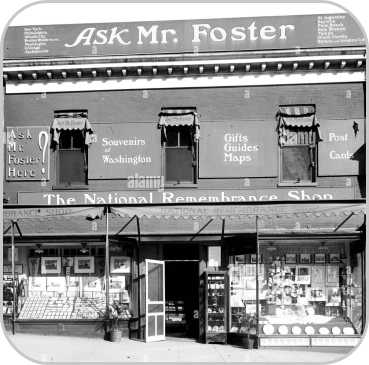
Taking advantage of this development, in 1924, Ward Grenelle Foster expanded on a concept he originally started in 1888. Innkeepers in his home city of St. Augustine, Florida, would send guests to him with their travel-related questions. “Go ask Mr. Foster,” they’d say. In a few short years, Ask Mr. Foster Travel opened more than 70 locations. His was the first large chain of tourist agents in the United States.
He only employed single women as agents. He was once quoted as saying: “women are more interested in the problems that come to them and have more graciousness in their attitude toward people.” Some say it was this policy that fueled the domination of the industry by women – something we still see today.
1931 : Commission and Travel Agents Arrive
With air travel becoming more affordable and commercial transatlantic flights on the horizon, steamship companies were getting nervous. Still seen primarily as a mode of transportation rather than a vacation itself, creating a more inviting and relaxing onboard experience required heavy investment.
At the same time, a small group of tourist agents had banded together to pressure the steamship companies into paying them for recommending their ships to clients. As a result, the idea of commission in exchange for reservations was born. However, when it was announced to the industry, it was not well-received.
Most tourist agents objected to commission. They argued: “We are now paid by our clients to provide honest, unbiased advice. Getting paid from a supplier would cast doubt on that advice!” They also said: “Part of our job is to find the best price, but commission is a reward for doing the opposite – it’s a conflict of interest and we’ll lose their trust.” Some even claimed: “This will be the death of the industry!”

1950: Travel Agent Hobbyist
At this time in our history, it was easy to make a profit just by booking reservations. Airline tickets were expensive with fares controlled by the government in both the United States and Canada. Commission for air was between seven and 10 per cent. A higher rate applied for tickets connected to a foreign independent tour” (aka FIT).
Commission from hotels, rail, cruises and tours were stable, and provided ample revenue. Basically, prices were high and the cost of operating an agency was relatively low. Almost anyone could make money in the business. That was good news and bad news.
Hobbyists flocked to the industry. Many of the regulations and controls which we have today had not yet been established. Travel agencies were opening everywhere, in big cities and small towns across North America. Combo-businesses appeared including travel agency/hair salons and travel agency/luggage and handbag shops.
1960-1970: Reservationist
An executive from a typewriter and office machine company called IBM had a conversation with another executive from American Airlines. IBM had been working on ways to commercialize their new computer system yet no one knew how it could be used. It was a solution looking for a problem.
Computers were a new and mysterious device to the average consumer. To capitalize on the progressive image they offered, it became fashionable for travel agents to take on the title of reservationist, or even computer reservationist. With airline tickets representing the largest source of revenue for most agencies at the time, the title made perfect sense.
1980-1990: Corporate Travel Agent
Although signed in 1978 by U.S. President Jimmy Carter, the Airline Deregulation Act took a few years to fully develop. Canadian airlines were deregulated in 1987. Both promised increased competition, more choices, better service, and lower fares.
Ticket prices indeed fell making it feasible for more business people to travel than in the past. Corporate travel exploded and captured the attention of agencies hoping to ride the wave of success. Becoming a corporate travel agent was the hot trend among travel pros of this decade.
During the same decade, in 1985 America Online became the world’s largest provider of a new (to most people) service called the internet! Its impact on travel would not be fully appreciated for several more years.
1992-2007: Leisure Travel Agent
Following years of declining airfares, increased costs, and multiple bankruptcies, most airlines started on the slow path of commission reductions. By 2002, almost all eliminated commission payments entirely.
On September 11, 2001, the horrific attacks on the World Trade Center in New York grounded all flights in the United States. Beyond the obvious tragedy, there was a near instant collapse of the corporate travel market.
There was also a massive shift back to leisure with the title leisure travel agent becoming the most common title in use. Also, most agencies began charging fees (initially just for air) for the first time since the 1930s.
2017: Travel Consultant
These days, most travel pros use the term travel agent in a generic sense, with most preferring travel consultant, travel advisor or something similar. You might say we have returned to our roots.
Many travel agencies today charge at least some type of fee. There’s more to the story, however, than fees alone. With the Internet and mobile travel apps, getting a reservation is simple for even the most tech-challenged traveller. Bookings are the easy part. Getting the right booking in the right resort, in the right destination for a client’s individual desires, is something only a human consultant can provide.
Perhaps this is one reason so many have adopted a title that more accurately reflects the real value they offer. Much like our travel ancestors from the 1920s, they have discovered that advice, guidance, service, support and peace of mind are things that almost everyone wants. Where there is a need or desire, there is a market to be fulfilled.
2019-2022: The COVID-19 Pandemc • — An Unprecedented Challenge
In 2020, the travel industry worldwide was about to be hit by a tsunami. As COVID-19 spread around the world, airlines were effectively shut down. People were told by their governments to stay home. Hotels and resorts were largely empty and cruise ships were forbidden to operate.
The Canadian government called all Canadians to return to Canada in March 2020, days ago March break holidays were to begin. Travel agents in Canada worked around the clock for weeks to bring customers home and to cancel future trips. It was chaos.
Travel agencies soon went to zero revenue. Or worse – negative.
Travel advisors then spent months trying to get refunds for their customers. Airlines negotiated financial support from the federal government and tour companies went dormant. Thousands were laid off or let go in the travel industry.
Present Time: Back in Business
After two extremely difficult years, and after losing more than 1,000 travel agents during the pandemic, the industry is now back on its feet and flourishing. Canadians are travelling again in large numbers.
Travel agents are in high demand because after all of the turmoil, customers feel safer working with an agent.
Throughout the entire history of travel in Canada, travel agents have proven to be remarkably resilient, adapting constantly to change, and dealing with every possible crisis and emergency the world can throw at them. Bravo!
History of the Canadian Travel Industry

A century of innovation and resilience
Travel agents have been around since the early part of the last century, making them the oldest members of the travel industry.
The first travel agents sold tickets on the various steamship lines that carried passengers to countries around the world.
Originally travel agents made bookings for their clients by phone, but gradually, computerized booking systems came into effect, followed by GDS systems. Agents went from writing paper tickets on ticket stock provided by shipping companies, airlines, tour operators and other suppliers – to issuing electronic tickets today that show up on the client’s smart phone!
Passenger airlines came about after WW11 when there was a proliferation of both aircraft and trained pilots, with travel agents eventually authorized to sell airline tickets.
Mass tourism began in the '70s
Mass tourism started to take off in the ’60s and ’70s with the arrival of jet aircraft. Scheduled airlines and charter tour operators began operating in the United Kingdom and Europe – using travel agents for distribution.
Canada followed soon after but due to federal regulations at the time, the only way tour operators could offer a charter flight was if the passengers were members of a club or affinity group.
The first charter trip to Cuba was in the early 1970s and was operated by Unitours, founded by Graham Atkin, who was granted permission to bring Canadian tourists to the communist island.
Around then, several other tour operators sprung up and either started their own charter airlines, or bought block space on scheduled airlines and negotiated rooms at resorts and hotels – operating one- and two-week holidays to places like the Bahamas, Jamaica, Hawaii and Barbados, and later expanding to Mexican resort areas and beyond. Thus, the package holiday!
Tour companies & charter airlines
The early tour companies in Canada included Strand Holidays, Golden Wing, Suntours, Paramount Holidays, Adventure Tours, Sunquest Vacations, Treasure Tours, Signature Vacations, Transat Holidays, Carousel Holidays, Regent Holidays, Conquest Vacations, Wardair Holidays, Nolitours, Tours Mont-Royal, CPAir Holidays, Sol-Vac, Mirabelle Tours & Touram—to name a few.
Meanwhile, the rules were eventually relaxed for charter airlines and they moved away from having to be affinity charters, but still operated under stringent regulations.
Several charter airlines came – and went. These included Worldways, Wardair, Canada 3000, Royal Aviation, Nationair, Zoom Airlines, Skyservice, Roots Air and more.
Failures brought provincial regulation
The collapse of many of these airlines and/or tour operators resulted in Canadians being stranded around the world and both Ontario and Quebec moved to regulate the travel industry, creating Compensation Funds and requiring tour operators and travel agents to pay a portion of their sales into the fund.
These regulatory bodies exist today as TICO in Ontario and the OPC in Quebec.
British Columbia does have some regulations but no compensation fund.
Canadian industry similar to U.K.
The travel industry in Canada was largely founded on the same model as the U.K. and parts of Western Europe. In fact, a lot of the original pioneers in Canadian travel immigrated to Canada from the U.K. and France.
The U.S. model grew in a different direction, with scheduled airlines providing the lift with only a few charter airlines in certain markets.
The Canadian travel industry comprised travel agents, charter tour operators with their own airlines, and wholesalers such as Red Seal and Holiday House. International coach tour companies, car rental companies and cruise lines all opened offices in Canada – as did companies specializing in Australia and New Zealand and Southeast Asia and China. But the majority of Canadians took package holidays each winter.
Throughout most of the 20th century, travel agents remained the primary distribution channel for all of these suppliers. They were originally either operating as independents or were part of an agency chain like Marlin Travel, Sears Travel or American Express.
Later, in the 1980s, various agency consortia formed and independents joined companies like Giants and Uniglobe and T-Comm. These groups negotiated commissions and overrides on behalf of their members and provided various marketing tools.
Canada's airlines
The story of Canada’s scheduled airlines could have many chapters, but today there are five established airline players in Canada, with several others just entering the market.
Canada’s national airline and flag carrier is Air Canada, first formed in 1937 through federal legislation as Trans-Canada Airlines to provide flights from coast to coast. An act of parliament changed the name to Air Canada in 1965. Eventually Air Canada became a public company. Through many ups and downs, Air Canada, today, is a major international airline.
WestJet was founded in 1994 as a low-cost alternative to Canadian scheduled airlines by Clive Beddoe, David Neeleman, Mark Hill, Tim Morgan and Donald Bell. WestJet soon became a public company and expanded its operations across Canada and to the U.S. and winter sun destinations.
Air Transat was founded in 1986 by Francois Legault, Jean-Marc Eustache, Philippe Sureau, Lina de Cesare, Yvon Lecavalier and Pierre Menard. Air Transat is now a public company and operates to many destinations in the Caribbean, Mexico and Central America as well as a large program to Europe.
Sunwing Airlines was launched in 2005 as a subsidiary of the Sunwing Travel Group. The airline was founded by Colin Hunter and Mark Williams. Sunwing operates across Canada providing international flights to sun destinations as well as domestic routes.
PAL Airlines is a regional airline based in St. John’s, Newfoundland serving Eastern Canadian gateways and is the second largest regional airline after Air Canada Jazz.
Porter Airlines was founded in 2006 by Robert Deluce, the former CEO of Air Ontario. Porter is a regional airline that operates Bombardier Q400 turbo-prop aircraft from its base at Billy Bishop Airport on the Toronto waterfront to destinations in Eastern Canada and the U.S.
In 2023, Porter entered a new era as it becomes the North American launch customer for next-generation Embraer E195-E2 jets, which will be deployed from Toronto Pearson International Airport.
The airline is expanding operations throughout North America, including to the west coast, southern U.S., Mexico and the Caribbean.
Canada Jetlines, an all-new leisure carrier based in Mississauga, ON, is also ramping up operations as it expands with new service to U.S. cities and south destinations, like Mexico.
Additionally, several low-cost airlines have entered the Canadian market in recent years. They include Edmonton-based Flair Airlines, as well as Calgary-based Lynx Air and Swoop, which is owned by The WestJet Group.
The '90s - a decade of disruption
A number of things happened in the 1990s – British tour conglomerates started buying Canadian tour companies. And then they started buying travel agencies and created vertical integrated companies that owned an airline, tour operator(s) and travel agencies.
This shift caused travel agencies to cry foul as there was concern the travel agencies owned by tour operators would get preferential pricing and commission. But generally, this turned out not to be the case. The tour operators had to ensure fairness, or they would lose support from the independent agency chains and consortia.
Around that time, some tour operators slowly started selling direct to the consumer which caused big protests from travel agents but in the end, it became clear that tour operators could only effectively service a small number of sales this way and the vast majority still came from travel agent.
The boldest move came in 2004 by a company called Go Travel Direct, started by Hugh and John Boyle from the U.K. With an aggressive marketing campaign aimed at travel agents, the company became a pariah. It subsequently failed to gain traction – but not without causing a major commotion in the industry.
And then came the game changer
Probably the biggest threat to travel agents was the arrival of the internet. There were many predictions of doom for travel agents. Now suppliers could easily bypass the travel agent and reduce distribution costs – and the internet provided the platform for the first online travel agencies (or OTAs).
The advent of the giant OTAs both in Canada and the U.S. was a major turning point. Companies like Travelocity, Expedia, Priceline, Orbitz, Kayak emerged. Soon, some of these companies started to discount making it hard for smaller agencies to compete.
In Canada, companies like iTravel2000 and SellOffVacations dominated the online discounting scene.
The internet has now been adapted by travel agents in many ways, including having their own bookable websites, online booking engines, social media and payment systems.
While store front travel agents were thought to be on their way out, they continued to exist across Canada.
2008 changed retail travel model forever
In 2008, during the global financial crisis, many travel agencies went out of business in the U.S. and the U.K. and this gave birth to the home-based travel agent.
These travel agents suddenly found themselves with plenty of clients but no travel agency. And so they serviced their clients from their homes and host agencies sprung up to support them. The phenomenon spilled over into Canada, although more slowly.
Today, over 50 per cent of travel agents in Canada are home-based, supported by large host agencies.
As commissions shrank over the years in various sectors of the industry, travel agents learned to apply service charges for their time. There was reluctance at first, but today, most travel agents charge fees for their services.
The COVID-19 pandemic - the industry's greatest challenge yet
In 2020, the travel industry worldwide was about to be hit by a tsunami. As COVID-19 spread around the world, airlines were effectively shut down. People were told by their governments to stay home. Hotels and resorts were largely empty and cruise ships were forbidden to operate.
The Canadian government called all Canadians to return to Canada in March 2020, days before March break holidays were to begin. Travel agents in Canada worked around the clock for weeks to bring customers home and to cancel future trips. It was chaos.
Travel agencies soon went to zero revenue. Or worse – negative.
Travel advisors then spent months trying to get refunds for their customers. Airlines negotiated financial support from the federal government and tour companies went dormant. Thousands were laid off or let go in the travel industry.
Boom times again
After two extremely difficult years, and after losing more than 1,000 travel agents during the pandemic, the industry is now back on its feet and flourishing. Canadians are travelling again in large numbers.
Travel agents are in high demand because after all of the turmoil, customers feel safer working with an agent.
Throughout the entire history of travel in Canada, travel agents have proven to be remarkably resilient, adapting constantly to change, and dealing with every possible crisis and emergency the world can throw at them. Bravo!